
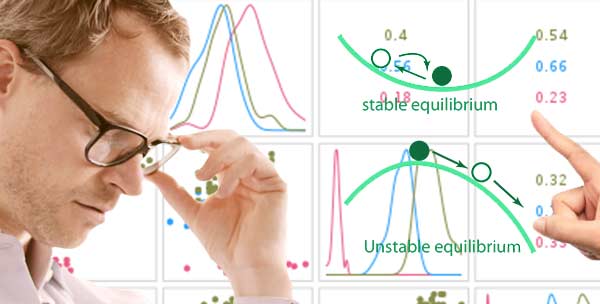
Stochastically stable equilibrium relates to evolutionarily statistics. The probability that the population is close to state S does not go to zero when there is vanishing noise present because it does not stop increasing.
It has been established that there is a relation between the dynamic user equilibrium and the game dynamics. We obtain rigorous results on the convergence of the solution as well as the stochastic stability of the equilibrium. In order to guarantee these results, it is essential to make stringent improvements to the utility of better response dynamics.
Stochastically stable equilibrium, also known as stochastic stability, is a concept in economics and game theory that refers to a situation in which a system is likely to remain in its current state, even when faced with random fluctuations or external shocks.
In economics, stochastic stability is often used to analyze market behavior and to understand how different policies or interventions might affect the stability of the market. For example, if a policy change causes the market to become less stochastically stable, it may be more likely to experience sudden shifts or changes. This can help policymakers and investors make better decisions about how to manage the market and avoid potential disruptions.
Overall, stochastically stable equilibrium is a valuable concept for understanding the behavior of complex systems, and can help economists and game theorists make more accurate predictions about how those systems will respond to changes and shocks.
The purpose of this study is to investigate the viability of dynamic user equilibrium (DUE) in unidirectional networks with fixed departure times. According to the findings, achieving a significant reduction in the amount of time it takes for users to complete a journey through the application of evolutionary dynamics is critical to the maintenance of a stochastically stable equilibrium.
In other words, a stochastically stable equilibrium is a situation in which the probability of the system remaining in its current state is high, even if there are small changes or disturbances. This type of stability is different from the more common concept of equilibrium, which refers to a state in which all forces are balanced and the system is not changing.
Stochastic stability is important because it allows economists and game theorists to understand how a system will behave over time, even when faced with random changes. This is particularly useful when dealing with complex systems, such as financial markets or social networks, where the behavior of individual agents can have a significant impact on the overall system.
The establishment of a stochastic model for the evolutionary public goods game in a population of finite size is presented here. There is a wide variety of factors that, when taken together, can effectively foster the development of cooperative behaviour.
In the 'noise model,' a theory of learning, randomness is used to model how a population learns by replacing ineffective players with new players. This process is called player replacement. It predicts that over time, as the need for experimentation decreases or the population becomes stable, the population will move towards evolutionarily statistical stable states. This can happen either when the population is stable or when the need for experimentation disappears.

Professor Dean Foster is a prominent figure in the field of game theory research. He currently works at the University of Maryland Amazon research. Statistics for Business: Decision Making and Analysis, published by Pearson in 2017 in Boston, is one of the many research papers that Dean Foster has written and had published. He has also written an article titled Economics for Business (Cambridge: Oxford University Press, 2016).
Peyton Young is a prominent figure in American economics and game theory. He has written extensively on statistical economic subjects his works have been widely published. In 1995, the Econometric Society elected Peyton Young to the position of fellow in the society.
Dean Foster and Peyton Young (1990) were the ones who initially developed the idea of stochastic stability. The theory of general finite-state Markov chains can be simplified into a form that is referred to as stochastic stability, which is easier to work with. If a state consistently receives positive weight in the stationary distribution of the Markov chain, then the state is considered to be stochastically stable. This is the conclusion he came to. The theory also demonstrates that residential segregation occurs at the social level even if no individual chooses to be segregated. This is the case even though no individual would choose to be segregated.
By resolving key issues in earlier mathematical economic models, game theory revolutionised economics. Neoclassical economics had a hard time dealing with imperfect competition and entrepreneurial anticipation. Game theory shifted focus from steady-state equilibrium to the workings of the market.
Game theory is useful in business for simulating conflicting actions of economic agents. Businesses frequently have to make a number of strategic decisions that influence their capacity to realise financial gain. A business may begin in position one and must choose between two possibilities. The final payoff amount is not known until the final decision has been processed because there are constantly other decisions that need to be made.

Ashly Chole - Senior Finance & Technology Editor